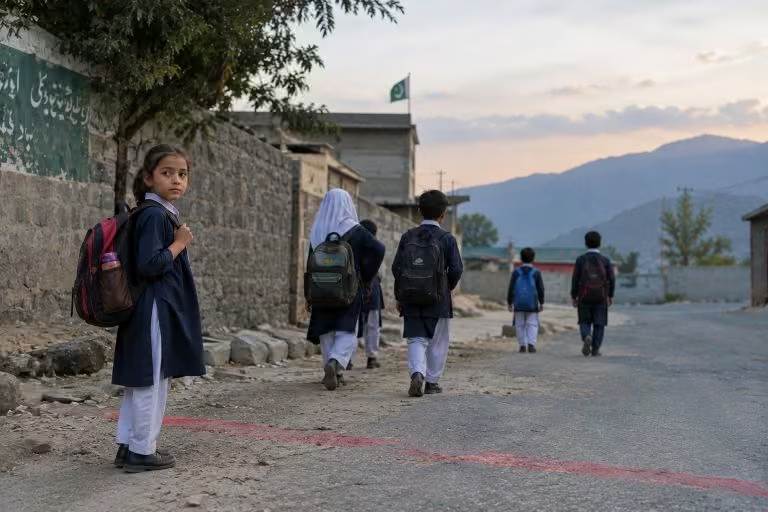
National security means protecting a nation from traditional and non-traditional threats. Mostly, however, it is understood as external security alone. Pakistan’s National Security Policy (NSP) has a comprehensive framework that is centred on people and the economy, and human security is its most fundamental factor. Pakistan talks about national security in terms of red lines, but only against external threats. Human security has failed because its most vulnerable citizens, its children, are not protected. The intractable problem of child rape and sexual abuse keeps rising day by day. The growing statistics have created grave concern and fear in society that children are not safe in their communities, homes, neighbourhoods and playgrounds. It should not be seen only as a criminal activity or a social issue but as a serious threat to human and national security.
Recent data collected by the child rights organisation Sahil highlights the rising number of rape and sexual abuse cases involving children. The data for 2025 shows that 3,630 cases of child abuse were reported across Pakistan. These include 522 cases of rape, 195 of attempted rape and 108 of gang rape, among other forms of mistreatment. The situation worsened by 8% compared with 2024.
Children are the most vulnerable citizens and should be the red line of national security.
Sahil’s report on child abuse in the first six months of 2026 shows that 1,914 cases were registered. Of these, 1,015 were cases of rape and sexual abuse. The breakdown by age and gender shows that children between 11 and 15 were the most frequently reported victims. The reported cases include 53% girls and 47% boys. The data does not stop here. These are only the reported and highlighted incidents. Unfortunately, most incidents remain hidden and undiscussed because of fear and the heavy pressure that society and the police put on victims’ families.
In August 2026 two cases crossed the threshold of patience, humanity and brutality. One was of 18-month-old Aizal from Karachi, and the other was of five-year-old Ayat Noor from Haripur. They are a question mark on every state institution. What national security is being provided to these children? Where are the authorities, the accountability, the law and order, the government and the humanity?
More than 1,000 cases of child abuse, kidnapping, missing children, abduction and other vulnerabilities are uploaded every day to the ZARRA (Zainab Alert, Response and Recovery Agency) database nationwide, yet the issue remains neglected. Governments, the judiciary and law enforcement agencies (LAEs) pay no attention to this problem.
Children are the most vulnerable citizens and should be the red line of national security. The NSP (2022-2026) was introduced as a comprehensive, citizen-centric framework. Human security is its first and top priority, but alas! The very first element of human security, “security”, is not available to the nationals of Pakistan, not even to children. On paper the policy looks cherishing, but at the implementation level it fails because of the lack of interest shown by the government and state institutions.
Prolonging and delaying rape cases only favours criminals.
Protecting the state and its territory from enemies, neighbours and terrorism does not guarantee peace and security until internal security is stable. Fighting terrorism on the borders will never bring final victory if the perpetrators of grave crimes, such as predators, roam freely around children. Only targeting and punishing them will make the environment safe and create peace. Ensuring freedom from fear among children is a broader part of national security.
Rape and sexual assault cases expose the weaknesses of the institutions responsible for protecting citizens. Poor and slow progress on rape cases, non-prosecution and the absence of a zero tolerance policy have allowed these crimes to continue and increase. Criminals in these cases are not held accountable, so the crimes neither stop nor decrease.
Child rape and sexual abuse can therefore be understood as an internal security challenge. Humans are the national element of the state, and national security without their security makes no sense. A country may have strong border security and military capability, but if its internal security is lacking, it is incomplete and vulnerable. The protection of children should be prioritised and included in the broader national security responsibility rather than being left to parents.
If human security is not protected, then traditional security does not matter.
Addressing these incidents requires an immediate and swift response. LAEs, police departments, child protection NGOs and state institutions must improve investigations and adopt a zero tolerance policy with exemplary punishment, such as public hanging of the criminal within a fixed period of the case being registered. Prolonging and delaying rape cases only favours criminals. Cases of sexual violence against children should be dealt with efficiently and immediately. Public awareness for child protection should be promoted. The government should install security cameras in every area, just as speed cameras are installed on roads. At the policymaking, security and implementation levels, all state institutions must work together to ensure the safety of children.
Pakistan’s National Security Policy is human-centric and made for the internal security of citizens. Children should be the first and topmost priority of the government and the state. The rise in child rape and sexual abuse cases has made the nation and its institutions fail. It is a grave failure for the state that its vulnerable and smallest citizens are not safe. If human security is not protected, then traditional security does not matter.
A secure Pakistan is not defined solely by protected borders but by the safety and dignity of its citizens, especially its children. Child protection must be a fundamental pillar of the National Security Policy to build a safe, fearless and progressive nation for future generations.