US, Iran and Regional Nations Express Confidence in Pakistan’s Mediation Role
In an official statement issued by the Foreign Office at the conclusion of the 2nd Meeting of Four Foreign Ministers — FM Dar confirmed that both Washington and Tehran have expressed confidence in Pakistan to facilitate direct talks between them. “Pakistan will be honoured to host and facilitate meaningful talks between the two sides in the coming days,” he said.
The seven-point summary outlined agreed positions: a unified call for an early and permanent end to the war, rejection of military escalation, support for UN Charter principles including sovereignty and territorial integrity, and a commitment to create conditions for structured negotiations. A committee of senior officials from all four foreign ministries will be constituted to work out modalities.
Dar further confirmed that Chinese FM Wang Yi and the UN Secretary General have also extended full support for Pakistan’s peace initiative, as have counterparts from multiple countries contacted by phone.
Quadrilateral Meeting Concludes; Four Nations Unite Behind Early End to War
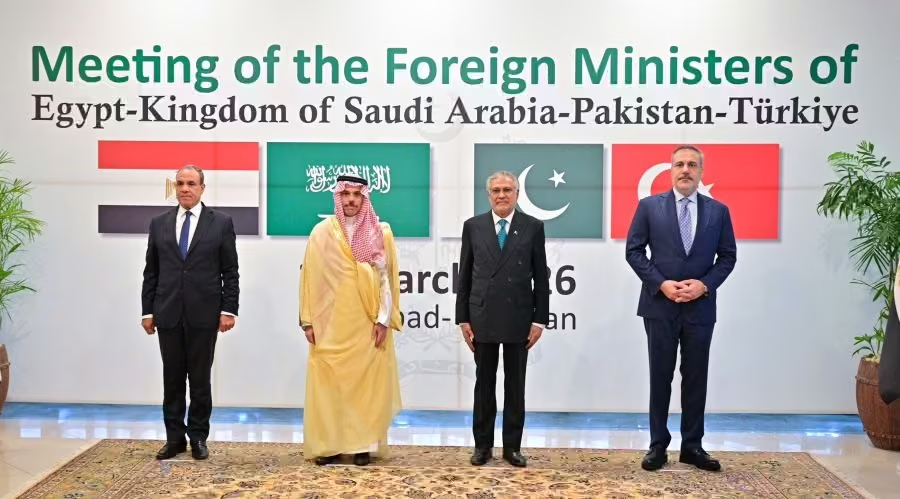
FM Dar, chairing the second quadrilateral session—the first was held in Riyadh on March 19 — said the four foreign ministers held “very detailed and in-depth” discussions on the regional situation and explored ways to bring an “early and permanent end to the war.” All four agreed the conflict “is not in favor of anyone” and reaffirmed unity to reduce military escalation and create conditions for structured negotiations. The visiting ministers gave their “fullest support” to Pakistan’s initiative to host US-Iran talks in Islamabad.
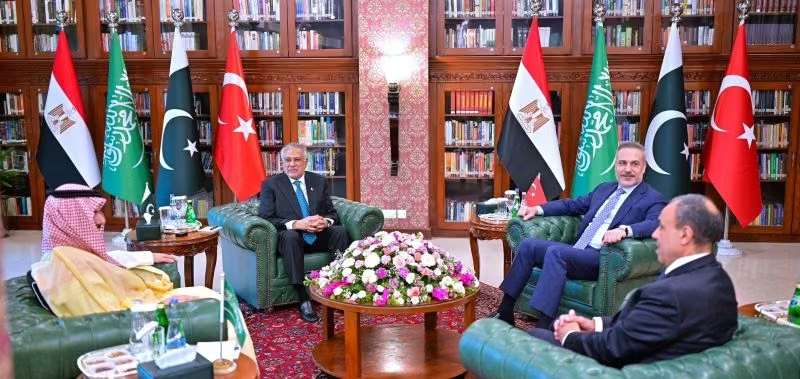
Ahead of the plenary, Dar held separate bilaterals with all three counterparts. With Turkish FM Fidan, both sides reaffirmed their strategic partnership and stressed sustained diplomatic engagement on Iran. With Egyptian FM Abdelatty, discussions covered de-escalation, Palestinian solidarity, and deeper bilateral cooperation, including trade and defense. With Saudi FM Prince Faisal, both sides underscored dialogue and collective efforts for regional peace and agreed to coordinate at bilateral and multilateral levels.
First Quadrilateral Session Concludes; Statement Expected
The first formal session of the four-nation ministerial meeting has ended at the Foreign Office. The meeting was held in a closed room. A joint statement from the Foreign Office is expected shortly. PM Shehbaz Sharif’s meetings with the three visiting foreign ministers—originally scheduled as a joint session today—may now be held separately, with the schedule under revision.
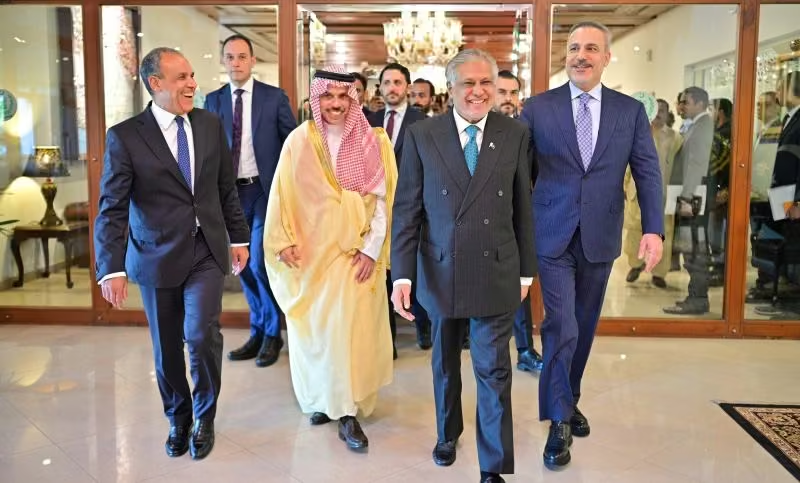
Meanwhile, significant context has emerged around the talks: Iran has already transmitted its formal response to the US 15-point peace proposal through Pakistan Dawn, meaning the four ministers have live Iranian positions on the table to work with. A senior source has indicated that direct US-Iran talks mediated by Pakistan could take place in Islamabad as early as next week, with a ceasefire possibly preceding that meeting. Dawn FM Dar has remained in active contact with Iranian FM Araghchi throughout the day, speaking to him before the session opened. Several thousand additional US troops have, meanwhile, arrived in the region NPR — a reminder that the military clock is running alongside the diplomatic one.
The foreign ministers of Saudi Arabia, Türkiye, and Egypt arrived in Islamabad on Saturday and Sunday as Pakistan convened its most significant diplomatic gathering in years—a quadrilateral meeting aimed at building a framework to end the US-Israeli war on Iran, now entering its second month with no ceasefire in sight.
The consultations, running March 29–30, were convened at the invitation of Deputy Prime Minister and Foreign Minister Ishaq Dar. All three visiting ministers held bilateral meetings with Dar before the four-nation session formally opened at the Foreign Office on Sunday, with Dar in the chair.
Turkish Foreign Minister Hakan Fidan landed at Nur Khan Airbase late Saturday and was received by Additional Foreign Secretary Syed Ali Asad Gillani. Egyptian Foreign Minister Dr. Badr Abdelatty arrived the same night, received by Additional Foreign Secretary Syed Ahmed Maroof. Saudi Foreign Minister Prince Faisal bin Farhan landed Sunday afternoon and was taken directly to the Foreign Office, where Dar received him for what both sides described as “comprehensive consultations on the evolving regional situation.”
The flags of all four nations flew outside the Ministry of Foreign Affairs as the delegations arrived—a visual marker of a meeting that diplomats in Islamabad have described as the most structured multilateral effort yet to find an exit from the Gulf crisis.
Pakistan’s Role
Pakistan did not arrive at this table by accident. Over the past several weeks, Islamabad has quietly positioned itself as the primary back channel between Washington and Tehran—two sides publicly denying they are talking while messages pass between them through Pakistani intermediaries.
FM Dar confirmed last Thursday that Pakistan is actively relaying indirect communications between the US and Iran, with Türkiye and Egypt running parallel tracks. The 15-point US peace proposal — which Tehran has called “one-sided and unfair” — was transmitted to Iran via Islamabad.
Iran’s government spokesperson said Sunday that Tehran “is willing to move toward a sustainable peace” —as the Islamabad talks got underway.
Prime Minister Shehbaz Sharif formalized Pakistan’s offer earlier this week, publicly proposing the country as a venue for direct US-Iran negotiations. The offer took on added weight when US President Donald Trump reposted it on his Truth Social platform — a gesture widely read in Islamabad as Washington’s tacit approval of Pakistan’s emerging role.
Iran’s response has been cautious but not closed. Government spokesperson Fatemeh Mohajerani said Sunday that Tehran “is willing to move toward a sustainable peace,” while reiterating its conditions: compensation for war damages, the lifting of sanctions, and resolution of the Hormuz question. Iran has separately laid out five formal conditions for ending the war. One Iranian official has dismissed the US proposal as “one-sided and unfair.” Tehran continues to publicly deny direct engagement with Washington.
A day earlier, Dar announced a small but telling confidence-building measure: Iran agreed to allow 20 additional Pakistani-flagged vessels to transit the Strait of Hormuz, two per day. Dar called it “a harbinger of peace.” Whether it holds will be watched closely.
What the Four Nations Want
All four countries gathered in Islamabad share a clear vulnerability: prolonged conflict in the Gulf directly threatens their energy supplies, trade routes, and economic stability. That shared interest is the foundation of this diplomatic effort.
Fidan, before departing Ankara, said the group would seek to establish a formal de-escalation mechanism. “We would discuss where the negotiations in this war are heading and how these four countries assess the situation and what can be done,” he told broadcaster A Haber.
In their bilateral with Pakistan, Egypt stressed restraint and resolution through dialogue, with both sides also raising Gaza—a reminder that the Palestinian question remains inseparable from any broader regional settlement. Pakistan reaffirmed its support for the Palestinian people and condemned Israeli aggression in Gaza and the West Bank.
The War They Are Trying to End
The conflict that brought these ministers to Islamabad began on February 28, when the United States and Israel launched what they described as a “pre-emptive” joint strike on Iranian targets. Supreme Leader Ayatollah Ali Khamenei was killed in those initial strikes. His son Mojtaba has since assumed leadership of the country.
In the weeks since, the war has spread. Lebanon has absorbed over 1,180 dead since Israeli strikes escalated on March 2, with healthcare workers and journalists among the killed. Yemen’s Houthi rebels have entered the conflict, firing missiles toward Israel. Iraq has seen strikes on Iran-aligned paramilitary positions. Kuwait’s airport radar was knocked out in a drone attack. Iran’s internet has been blacked out for 30 consecutive days.
The Strait of Hormuz—through which roughly a fifth of the world’s oil passes—remains the war’s sharpest economic pressure point. For Pakistan, the costs are tangible: fuel import bills are up, shipping insurance has surged, and remittances from millions of Pakistanis across the Gulf are under threat.
In Washington, exiled Iranian royalist Reza Pahlavi drew standing ovations at CPAC this weekend, urging the US to press its military campaign and pursue regime change in Tehran. It is the loudest counter-narrative to everything being attempted in Islamabad.
From the Corridor, Through a Reporter’s Lens
The meeting that may help end a regional war was held, as diplomats prefer it, behind closed doors—in camera, away from the cameras. Outside the Foreign Office, one of the largest media scrums Islamabad has seen in years pressed against the margins of the building. Journalists from across the region waited. Officials walked past them with studied purpose, eyes forward, questions unanswered.
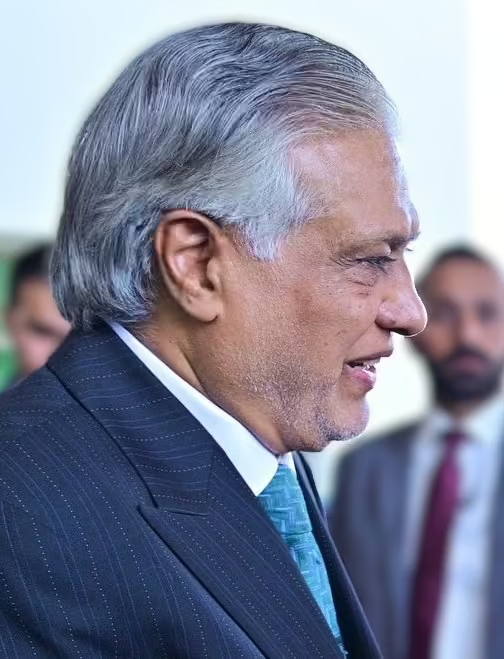
Once a punchline in Pakistani political conversation, Ishaq Dar is today the man whose name appears in diplomatic dispatches from Ankara, Riyadh, Cairo, and Tehran
The one figure who has been impossible to miss throughout is Deputy Prime Minister Ishaq Dar—chairing the session, working the phones, keeping Tehran on the line. It is worth pausing on that. Not long ago, Dar was a punchline in Pakistani political conversation—the finance minister whose tenures became synonymous with economic mismanagement. Today, his name is in diplomatic dispatches from Ankara, Riyadh, Cairo, and Tehran. Whether history will be generous about how Pakistan arrived at this moment is a separate question. What is not in dispute is who is running the room.
The Question Islamabad Cannot Answer Alone
What Pakistan can do — and is doing — is keep the conversation alive and give both sides a room that neither has to officially acknowledge. Whether the Islamabad talks produce a concrete mechanism or remain a statement of collective intent will ultimately depend on decisions made in Washington and Tehran, not Islamabad.
For now, Pakistan is the room where that question is being asked—and the four flags outside the Foreign Office are the clearest sign yet that it is not asking alone.