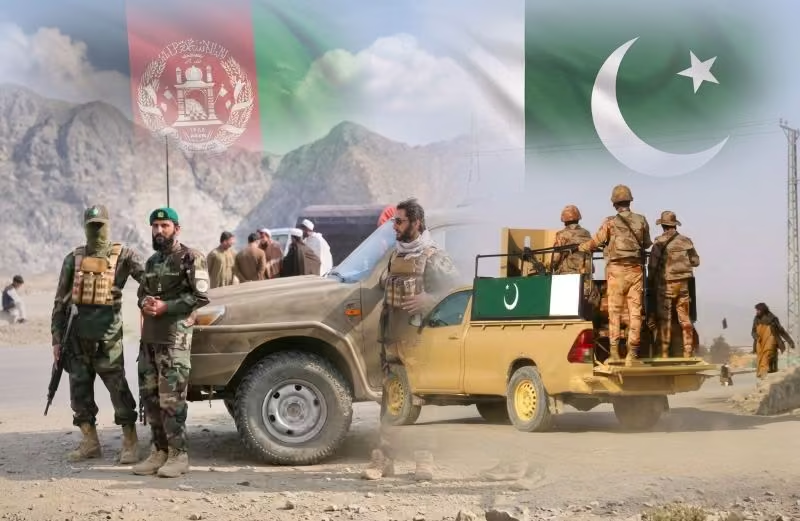
The relationship between Pakistan and Afghanistan has undergone a drastic transformation, which started from a symbolic alliance to a state of severe crisis and ended up with open war in 2026. Pakistan welcomed the Taliban regime in Kabul as a natural ally, while Afghanistan always had a complicated view and history with Pakistan. This complicated relation started when the British colony made the Durand Line a formal border dividing both regions of Afghanistan and, nowadays, Pakistan. This Durand Line was never formally recognized by Afghanistan, while Pakistan officially recognized it. Neither the Taliban government in the 1990s nor the current Taliban government endorses this Durand Line.
Pakistan had a good relationship with the Afghan Taliban in the 1990s. Pakistan was one of the first three countries to recognize the Taliban regime as a legitimate government when they came to power in 1996, alongside Saudi Arabia and the United Arab Emirates. But following the collapse of the Taliban regime in 2001, Pakistan and Afghanistan relations became strained as Pakistan officially joined the War on Terror initiated by the USA. Because of this, cross-border terrorism turned into border skirmishes.
Other than having border clashes with Afghanistan, Pakistan also faced several challenges from Tehreek-e-Taliban Pakistan (TTP). TTP formed in areas near the Pakistan border; those areas were known as the Federally Administered Tribal Areas (FATA) until 2018. TTP wants these areas to be semi-autonomous. These areas are also where most of their operations took place — just like in 2014, when they attacked the Army Public School in Peshawar, in which more than 130 children were killed.
From 2014, Pakistan’s military operation Zarb-e-Azb tried to push the TTP out, and those militant groups then found refuge in North Waziristan and other tribal areas of Afghanistan. Some border areas of Afghanistan like Kunar, Nangarhar, and Khost are likely to be TTP training areas. When the Afghan Taliban came back to power in 2021, Pakistan hoped that they would help counter these security threats, but Afghanistan completely rejected these ideas. During an interview, Afghan Taliban government spokesperson Zabiullah Mujahid said that the TTP is Pakistan’s internal issue.
By the start of 2025, the relationship between both states worsened as intermittent strikes, drone strikes, and skirmishes intensified. By October 2025, Pakistan carried out air strikes on Kabul targeting TTP leader Noor Wali Mehsud. Pakistan claimed to have eliminated key leaders, but this was denied by the TTP. By February 2026, Afghan Taliban forces attacked Pakistan border checkposts near their disputed areas, claiming that Pakistan had attacked their sovereignty first. Afghanistan claimed that 55 Pakistani soldiers were killed while eight of its fighters were dead. Within hours, Pakistan responded by launching a military operation named Ghazab-lil-Haq, bombing several Afghan border provinces and the capital, Kabul. Pakistan’s defense minister later described the situation as one of open war with Afghanistan.
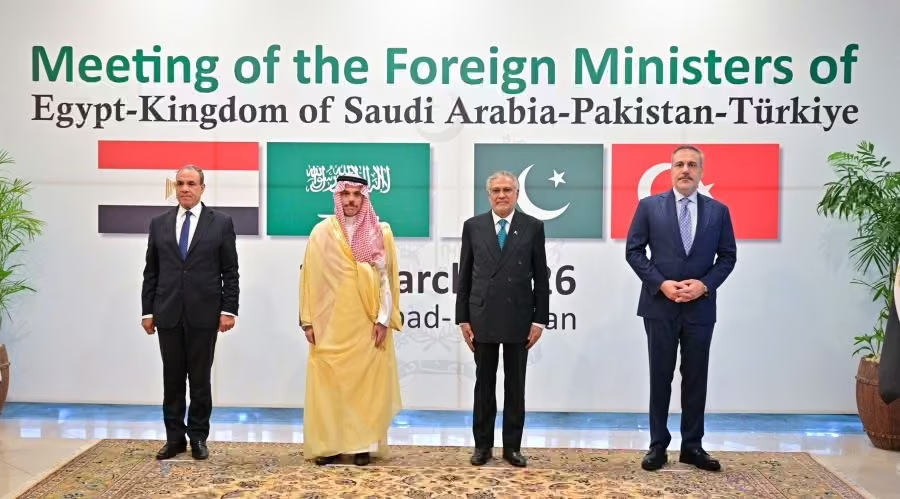
There are two possible outcomes of this war—one could be de-escalation, which is much needed for both states, and the other is the continuity of war and clashes. But seeing that Pakistan has started open war against Afghanistan, there may be chances of further escalation or military action. As we have seen, the mediating role of the Middle East during October 2025 helped to resolve the conflict, and due to that, both countries agreed to a ceasefire, first in Doha and then in Istanbul in October, and also through Saudi-led mediation efforts. But due to current instability in the Middle East, it seems difficult for Gulf states to play a role in mediating these tensions.