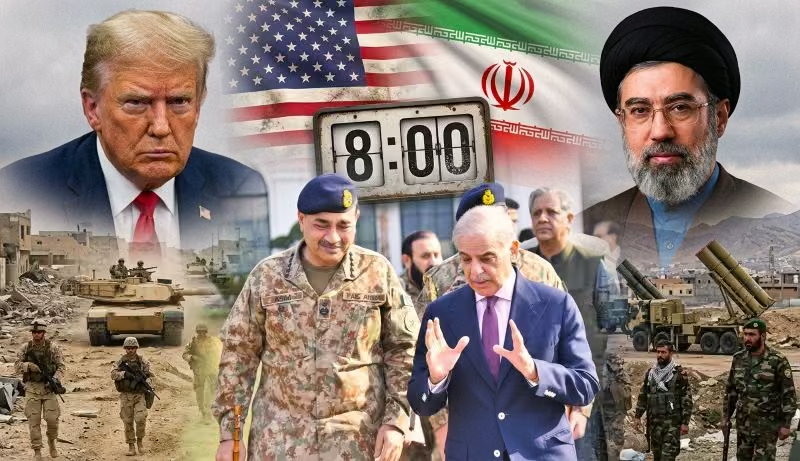

JD Vance walked out of the Serena Hotel before dawn on Sunday, stood briefly before the cameras, thanked Pakistan, framed the outcome as Iran’s failure, and boarded Air Force Two for Washington. No agreement. No joint statement. After 21 hours on Pakistani soil—16 of them in active negotiation—the American vice president left with what he called a “final and best offer” still on the table, and Iran had not taken it.
Every outlet ran the same story: no deal, talks collapse, Vance departs, negotiations fail. That story is accurate. It is also incomplete, and in its incompleteness it misses what actually happened in Islamabad—and what it means for everything that comes next.
The failure narrative wrote itself. It is also, on examination, the wrong frame.
Inches Away
Before anything else, one line from Iranian Foreign Minister Abbas Araghchi needs to be placed at the centre of any honest account of these talks. Writing on X, Araghchi said: “In intensive talks at highest level in 47 years, Iran engaged with US in good faith to end war. But when just inches away from ‘Islamabad MoU’, we encountered maximalism, shifting goalposts, and blockade.”
Inches away from a Memorandum of Understanding.
That phrase—from Iran’s chief negotiator, a veteran diplomat who served as deputy chief negotiator in the 2015 nuclear deal and ran its day-to-day technical sessions—is the most significant piece of information to emerge from the entire 21-hour session. It means the talks did not break down over fundamental incompatibility. They broke down in the final stretch, over a single issue, when both sides were close enough to an agreement that it had a name. The Islamabad MoU. It nearly existed. The nuclear question prevented it from existing.
Araghchi’s phrase—inches away from “Islamabad MoU”—does not appear in any headline calling Islamabad Talks a failure.
Federica Mogherini, who spent 12 years helping negotiate the 2015 Joint Comprehensive Plan of Action—the multinational Iran nuclear deal that constrained Tehran’s enrichment programme in exchange for sanctions relief, and which President Donald Trump abandoned in 2018—put the timeline in its proper context: “It took us 12 years and an immense amount of technical work. Anyone seriously thought an agreement could be reached in 21 hours?”
The answer, from everyone who spent Saturday and Sunday in Islamabad, is no. No one expected a final agreement. What no one expected either was how close one came.
Reading JD Vance’s Remarks Past the Posturing
Strip the posturing from Vance’s departure statement and what remains is more considered than it first appears.
He thanked Pakistan with the kind of specificity that is not protocol—naming Prime Minister Shehbaz Sharif and Field Marshal Asim Munir personally, stating the shortcomings of the talks were not Pakistan’s fault, that Islamabad had done “an amazing job” trying to bridge the gap. That is the language of a delegation that wants the door to stay open and needs its mediator present in every room this region produces going forward. It is not the language of a team that is burying a process.
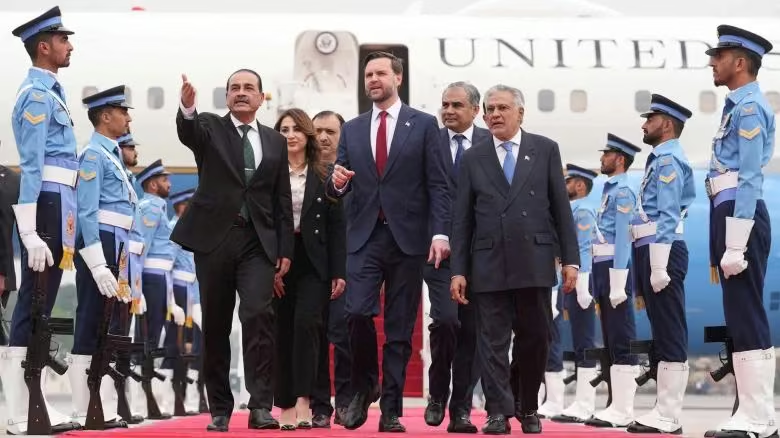
Vance confirmed that the US made its position explicit—red lines stated, accommodations defined, the offer placed on the table. “We leave here with a very simple proposal, a method of understanding that is our final and best offer. We’ll see if the Iranians accept it.” That sentence is not a door closing. It is a door left ajar with a condition attached.
The delegation was not operating in isolation from Washington’s broader national security architecture. Vance confirmed the team was in contact not only with President Trump but also with Secretary of State Marco Rubio, Secretary of Defense Pete Hegseth, Treasury Secretary Scott Bessent, and CENTCOM commander Admiral Brad Cooper throughout the 21 hours. The breadth of that coordination—spanning diplomatic, military, and economic channels simultaneously—reflects how seriously Washington approached the session, whatever the surface outcome suggests.
Vance did not bury this process. He left an offer on the table, praised the host and boarded his plane. That is the behaviour of a party in recess, not a party that has walked away.
On the nuclear question, Vance was explicit about what the US wanted: “We need to see an affirmative commitment that they will not seek a nuclear weapon and they will not seek the tools that would enable them to quickly achieve a nuclear weapon. That is the core goal of the president of the United States.” Sources briefed on the talks confirmed the specific sticking point: Iran’s refusal to surrender its existing enriched uranium stockpile. The US is not asking for a promise about the future alone. It wants the material gone, the capability dismantled, and the ambition formally and permanently renounced.
Republican senators Lindsey Graham and Tom Cotton had already warned publicly that Senate ratification of any agreement requires full dismantlement—narrowing whatever room Vance’s team had to offer Iran a phased approach.
This demand is a fundamental shift from the entire architecture of past Iran nuclear diplomacy. The JCPOA was built around managing a functioning programme through verified limits. What the Islamabad talks were attempting in 21 hours was structurally more demanding than anything that agreement required: extracting from Iran a permanent, sovereign renunciation of nuclear ambition—in the immediate aftermath of a war Iran did not start and in an atmosphere both sides openly described as complete mutual distrust.
That Iran declined is not surprising. That they came inches from an MoU before the nuclear question ended it is the detail that reframes the entire episode.
Iran’s Version—And Why It Holds
Tehran’s response to Vance’s framing was immediate, coordinated, and pointed.
Iran’s Foreign Ministry spokesperson Esmail Baghaei said the two sides had “reached an understanding on a number of issues” with differences remaining on “two or three important matters.” He added that “no one expected” a comprehensive agreement from a single meeting held after 40 days of war in an atmosphere of admitted mutual suspicion. When asked whether diplomacy had ended, his answer was three words: “Diplomacy never ends.”
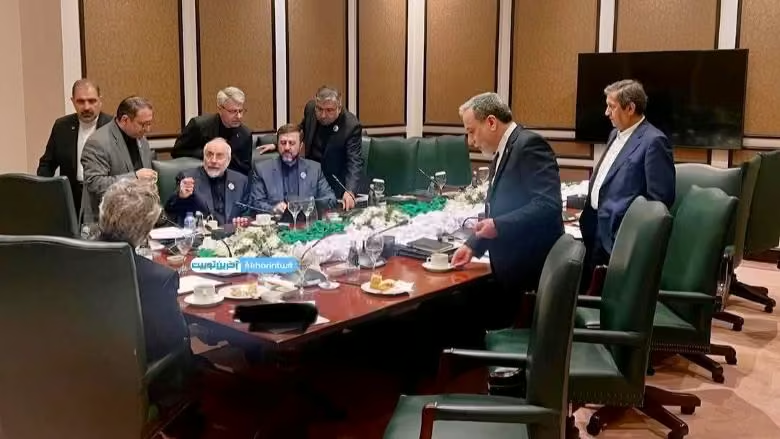
Ghalibaf was more direct. “The US has come to understand Iran’s logic and principles, and now it must decide whether it is capable of gaining our trust.” He noted that before the talks began, he had told his delegation they had the necessary good faith and will—but no trust in the opposing side. “The opposing side ultimately failed to gain the trust of the Iranian delegation in this round of negotiations.”
Iran’s Ambassador to Pakistan, Reza Amiri Moghadam, offered the most structurally significant Iranian framing: the Islamabad Talks are “not an event but a process.”
Iran is in no hurry. Every day without a deal is a day the economic pressure continues—on the world, and on an American president whose domestic political position is weakening.
These three statements—Araghchi’s inches from an MoU, Baghaei’s diplomacy never ends, the ambassador’s not an event but a process—form a coherent position, not spin. They are the Iranian diplomatic record on what happened. Iranian President Masoud Pezeshkian added his own framing: “If the American government abandons its totalitarianism and respects the rights of the Iranian nation, ways to reach an agreement will certainly be found.”
There is a harder reading too, offered by Mohsen Farkhani of the University of Isfahan, who argued that Iran entered the talks not for a breakthrough but to demonstrate to the world that Washington was not serious—that Iran was using the talks to prove, for a third time, that the US could not be trusted at the negotiating table. This reading cannot be entirely dismissed. But it sits uncomfortably alongside the evidence of five consecutive rounds, 16 hours, multiple draft exchanges, and—most pointedly—a foreign minister who says they were inches from an MoU. Parties performing theatre for international audiences do not typically get that close.
The Strait and the Bomb: Where the Talks Actually Broke Down
Three red lines defined the American position in Islamabad, not one. Every substantive account of the sessions—and Trump’s own subsequent posts—confirms all three: no nuclear weapons or the tools to build them, the Strait of Hormuz opened unconditionally, and strict limits on Iran’s ballistic missile programme.
On the strait: Iran’s position is structural. The Strait of Hormuz—the narrow waterway through which roughly 20 per cent of the world’s oil and liquefied natural gas passes—is the mechanism through which Iran intends to recover the costs of a war it was subjected to, assert sovereignty over its adjacent waters, and secure guarantees against future attack. The near-closure of the strait has been described as the worst economic shock to global energy markets since the 1973 oil embargo—that embargo removed 4.5 million barrels per day from global supply; the Hormuz blockade has blocked 20 million. The proposed transit fee is simultaneously a reconstruction financing instrument and a sovereignty declaration. Farkhani was explicit: “It is not American business to patrol in this strait.”
Iran has leverage, patience, and oil prices working in its favour. The American president has an approval rating that is not. The clock does not tick equally for both sides.
The American position on the strait has been, inconveniently, incoherent. Within ten days of the Islamabad talks, Trump took two publicly irreconcilable positions: first that the strait was none of America’s business; then that it was front and centre to US demands. The Pentagon reported two US guided-missile destroyers transited the strait on Saturday as part of a mine-clearing mission, the first American warships to do so since the conflict began. Iran disputed elements of the account. The practical reality is that Iran still controls the Hormuz waterway. Only a dozen vessels had been recorded transiting since the ceasefire began, at the time of publication—against a pre-war average of over 100 ships per day.
On the nuclear commitment: Iran’s 10-point plan contained no mention of a complete surrender of nuclear ambitions. Under the 2015 JCPOA, Iran had agreed to cap enrichment at 3.67 per cent. Since Trump withdrew from that agreement in 2018, Iran has accelerated enrichment to 60 per cent. Ninety per cent is required to produce a weapon.
The US strikes targeted Iran’s three main nuclear sites—Natanz, Isfahan, and Fordow—but Iran’s enriched stockpile was not fully eliminated. What the US is now demanding is not just a weapons pledge but the physical removal of remaining enriched material, full dismantlement of surviving infrastructure, and a permanent commitment not to seek even the tools for a rapid weapons capability.
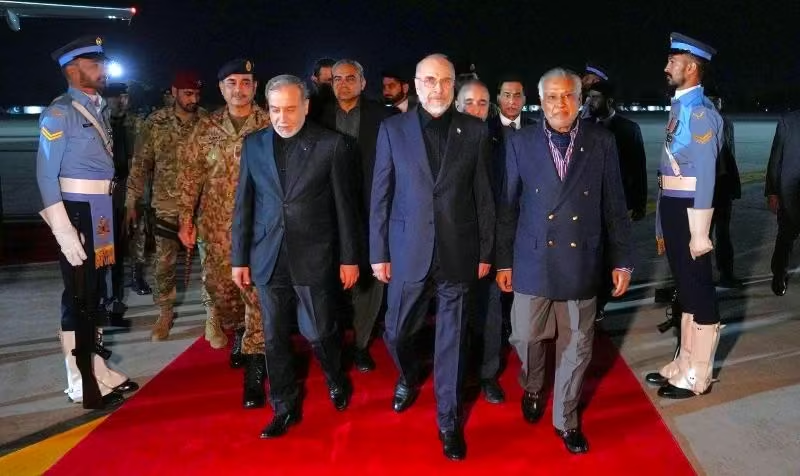
A professor at the University of Tehran, Foad Izadi, offered a sharper reading: the nuclear focus is a way of papering over deeper US goals. “The nuclear programme is an excuse to achieve other goals”—including Iranian oil, border changes, and regime change. “These are the more serious subjects they’re interested in—not the nuclear programme.” Whether or not one accepts that entirely, it captures why Iran cannot accept the nuclear demand as framed: because in Tehran’s reading, it is not really about the nuclear programme at all.
What Trump Was Actually Doing—And What He Did After
There was a structural limit on the American side that explains both how close the talks came and why they ultimately stopped short. JD Vance led the delegation, but he was not its final authority. Before departing Washington, he had said publicly that Trump provided him with “pretty clear guidelines.” Officials familiar with the process confirm that the eventual blockade announcement was not an impulsive reaction to the talks failing—it was a pre-authorised step, prepared before Vance boarded the plane, designed to be deployed if Iran did not meet specific US conditions.
Vance was accompanied by Steve Witkoff and Jared Kushner—both Trump confidants, neither career diplomats—which analysts read as an additional measure ensuring the delegation would not deviate from the White House’s fixed position. When the talks reached their most sensitive phase, Vance could listen and relay, but not recalibrate. Pakistan’s mediation carried the process to the threshold of an agreement. What prevented its closure was not a collapse at the table but the ceiling of American decision-making at the moment the final inches needed closing.
Trump announced a blockade. Iran said diplomacy never ends. Both statements are, in their own way, negotiating positions.
While his vice president was in hour fourteen of negotiations, Donald Trump was at a UFC event in Miami. His secretary of state was at the same event. Vance confirmed consistent contact with the president throughout—a dozen calls across 21 hours—but the optics of the most significant US-Iran engagement since 1979 unfolding while the president watched a fight in Miami were not lost on anyone, least of all Tehran.
Then, after Vance’s plane left Islamabad, Trump posted on Truth Social and transformed the situation in three moves.
He confirmed that “most points were agreed to”—the most explicit US acknowledgement yet of partial progress—and that the nuclear question was the sole breakdown point. He praised Pakistan warmly and named Field Marshal Munir and PM Sharif specifically. Then came the blockade: effective immediately, the US Navy would interdict every vessel in international waters that had paid a toll to Iran. He warned that any Iranian who fires at US forces or peaceful vessels will be “BLOWN TO HELL.” A further post placed all US military assets on standby around Iran until a real agreement is fully complied with.
This sequence needs to be read carefully. The blockade announcement came after Vance’s departure—not before, not during. It functions simultaneously as a pressure escalation, a domestic political performance, and a negotiating signal to Tehran that the clock is running. Trump’s own language—”most points were agreed to,” the warm praise of Pakistan, the offer still on the table—sits in direct tension with the maximalist threats. Both things are true at once. That is how Trump has managed this crisis from the beginning: the diplomat in the room and the threat from Washington, running in parallel, neither fully cancelling the other.
Ghalibaf’s response was immediate: “Such threats have no effect on the Iranian nation. If you fight, we will fight. If you come with logic, we will respond with logic.”
Netanyahu and the Room Pakistan Could Not Fully Protect
There is one actor who was not in the Serena Hotel but whose presence was felt throughout: Benjamin Netanyahu. Pakistani diplomats, speaking to Al Jazeera on condition of anonymity, said that Israeli bombardment of Beirut during the talks—Israel’s military struck more than 200 Hezbollah-affiliated targets in Lebanon in the 24 hours around the sessions—sabotaged the atmosphere in ways Pakistan could not fully contain. Defence and foreign policy specialist Mushahid Hussain Syed was direct: Netanyahu is “the real warmonger” who has been “pushing the US into continuing this war of aggression unnecessarily.”
Pakistan could bring both sides to the table. It could not stop a third party from attacking a fourth while the first two were attempting to talk. That is not a failure of Pakistani mediation. It is the limit of what any mediator can do when one party’s closest ally is conducting operations the mediator has no authority over.
Sources suggest an informal understanding may have emerged that Israeli operations would be confined to southern Lebanon with no further strikes on Beirut. That remains unconfirmed. If true, it would be a meaningful side outcome—one that no headline about the “failed” Islamabad talks has yet acknowledged.
What Pakistan Actually Achieved—The Honest Account
FM Ishaq Dar’s official statement at the conclusion of the talks was measured and deliberate. Pakistan had helped mediate “several rounds of intense and constructive negotiations” that “continued through the last 24 hours.” It was imperative that both parties “continue to uphold their commitment to ceasefire.” Pakistan “has been and will continue to play its role to facilitate engagement and dialogue between the Islamic Republic of Iran and the United States of America in the days to come.”
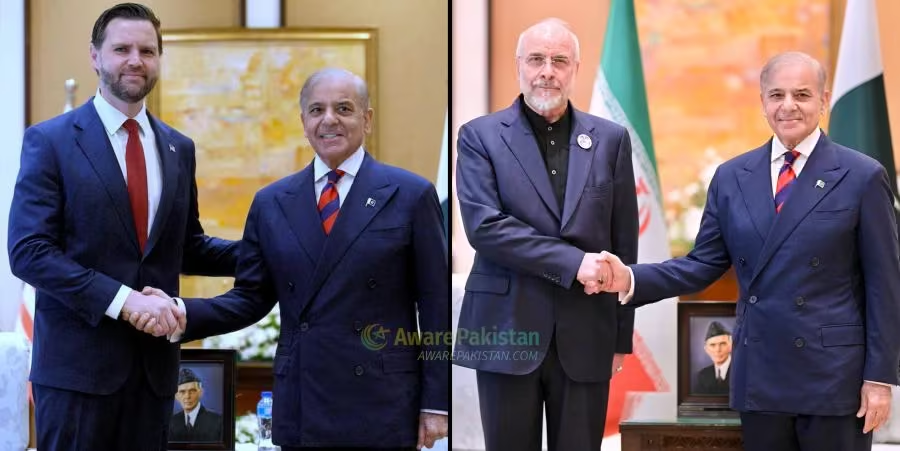
That is not the language of a country whose diplomatic ambitions ended in the Serena Hotel. It is the language of a mediator both Washington and Tehran have trusted simultaneously—not as a venue, but as the only credible interlocutor both sides have accepted across every stage of this conflict.
Pakistan’s role in this crisis has always been larger than any single round of talks. It is the only party that has earned the right to be in that room—through geography, through relationships built over decades with both sides, and through a civil-military alignment that no other country in the region can currently replicate.
Qamar Cheema of the Sanober Institute put Pakistan’s achievement in its correct frame: “Pakistan’s job was to bring them on the table. Pakistan’s job was to bridge the gap and rebuild the trust, and Pakistan has done its job. Both sides praising Pakistan—that is global recognition.” He added: “We do believe that in the coming days, they will come back with whatever they have been offered. So it’s a continuous process.”
Pakistan could bring both sides to the table. It could not stop a third party from attacking a fourth while the first two were attempting to talk.
The structural achievement of the Islamabad talks is this: Pakistan got two parties with no direct diplomatic relations, no trust, a 47-year history of hostility, and six weeks of active war behind them into the same room, at the same table, for 16 hours of substantive negotiation—close enough to an agreement that it had a name. Oman had managed proximity talks. Europe had managed multilateral frameworks. Neither produced face-to-face contact at this level of seniority, nor got within inches of a signed understanding. Pakistan did.
Both parties, having failed to agree with each other, publicly agreed on one thing: Pakistan’s channel is the one worth preserving. Trump named Munir and Sharif. Ghalibaf thanked Pakistan by name. Araghchi cited the blockade as what stopped the MoU—not Pakistan’s mediation. The Iranian ambassador called it a process, not an event. Every statement, beneath the posturing, pointed back to the same address.
What Comes Next
The entire US delegation has left Pakistan. Vance, Witkoff, Kushner, and the full technical team departed together from Ramstein. No one stayed behind for backchannel discussions. What follows—if anything follows—will be indirect, at lower levels, through Pakistani intermediaries.
Trump’s naval blockade has changed the immediate operational reality on the water. Diplomatically, the picture is paradoxically more open than the headlines suggest. A final offer is on the table. Iran has not formally rejected it. Ghalibaf has told Washington it needs to decide whether it can earn Iran’s trust. Araghchi said they were inches away.
For a nation that spent years as a footnote in other people’s geopolitical dramas, being the venue where the United States and Iran sit in the same building is something else entirely.
Australia’s Foreign Minister Penny Wong said it plainly: “The priority now must be to continue the ceasefire and return to negotiations.” That message—from Canberra to Ankara to Beijing to the UN—is consistent. No one who watched Saturday’s session believes the alternative to negotiation is anything other than resumed hostilities on a larger scale.
The war is not over. The offer is on the table. The blockade has begun. And somewhere between those three facts lies the next round—whenever both sides decide they are ready to close those final inches.
Pakistan has already said it will be there when they are.