TOPLINE
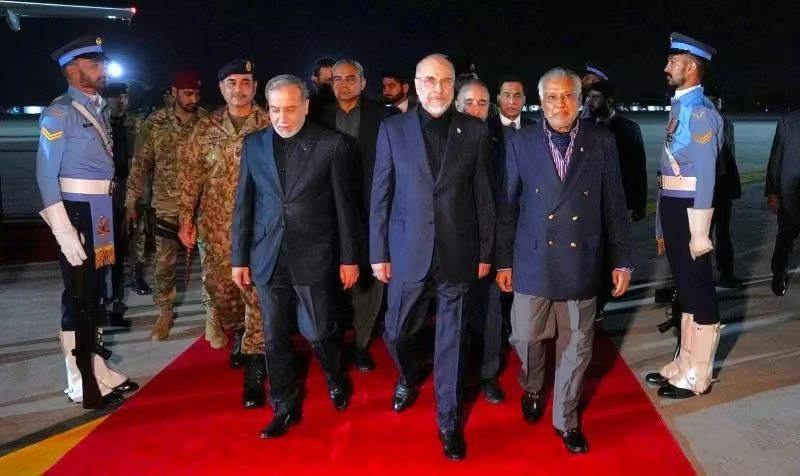
Iran’s delegation, led by Parliament Speaker Ghalibaf and Foreign Minister Araghchi, has arrived in Islamabad for the first direct US-Iran ceasefire talks since 1979, brokered and hosted by Pakistan. The talks open Saturday at the Serena Hotel in a proximity format — both sides in separate rooms, Pakistani officials carrying messages between them. Lebanon is already the flashpoint: Iranian strikes in Beirut overnight have put Tehran’s red line back on the table before the first session begins.
Iran Enters Talks From Strength, Not Desperation
Iran is entering the Islamabad talks from a position of confidence, not concession, according to Professor Zohreh Kharazmi of the University of Tehran. Speaking to Al Jazeera, she argued that the talks themselves represent a shift in Washington’s stance — pointing out that as recently as 6 March, Trump was demanding unconditional surrender. The US is now at a negotiating table.
“Iran is firm about its conditions,” Kharazmi said. “And at least some of the critical ones will be approved — maybe not in this round, but in the rounds to come.”
On the Strait of Hormuz, Kharazmi said Iran’s Supreme Leader has again made clear the waterway will not be surrendered lightly, and that Tehran views control of the strait as the mechanism through which it intends to recover the costs of the war.
Islamabad Talks ‘high stakes, very little margin of failure’
Former US ambassador Henry S. Ensher has warned that the Islamabad negotiations carry exceptionally high risk, largely because of the senior level at which both sides are engaging.
“This is really high-risk stuff for a bunch of reasons,” Ensher told Al Jazeera. He said talks usually begin at lower levels to allow room for escalation if progress is made—a cushion that does not exist when negotiations start “at the top or near the top”.
“If this fails, it’s hard to see what we and the Iranians would do next,” he said.
Ensher also flagged political risks for JD Vance, who is leading the US delegation. He warned that failure—marked by more bombing, wider destruction, economic fallout, and strain with allies—could seriously damage Vance’s political future.
Iranian Delegation Lands in Islamabad, Confirming Talks Will Proceed
The Iranian delegation, led by Parliament Speaker Mohammad-Bagher Ghalibaf, has arrived in Islamabad for the ceasefire talks, Iranian media is reporting. Other key figures in the delegation are:
Iran’s Parliament Speaker Mohammad Bagher Ghalibaf
Iran’s Foreign Minister Abbas Araghchi
Secretary of the Supreme National Defense Council Ali Akbar Ahmadian
Central bank governor Abdolnaser Hemmati
Former IRGC commander Mohammad Bagher Zolghadr
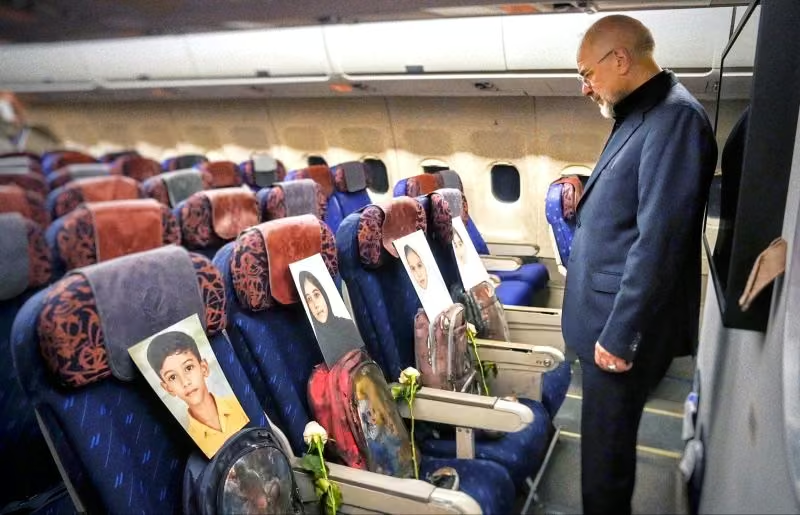
Several members of Iran’s parliament have also joined the delegation, according to Iranian media.
Pakistan’s Foreign Ministry has formally confirmed the delegation’s arrival in Islamabad, saying the Iranian officials were received by Pakistan’s Foreign Minister Ishaq Dar along with other senior Pakistani officials.
This effectively marks the start of the Islamabad phase of the talks.
The streets leading into the Red Zone were empty. Rangers and army personnel stood at multi-layered checkpoints along roads that would normally be thick with evening traffic. Snipers had taken position on government rooftops. The Serena Hotel — cleared of all private guests since Thursday, ringed by a security perimeter that rendered it a sealed diplomatic compound — sat waiting. Pakistani, American, and Iranian flags flew together on stretches of the city’s main avenues, an image that would have been unthinkable six weeks ago. Islamabad had not looked like this before, and that, in itself, was the story.
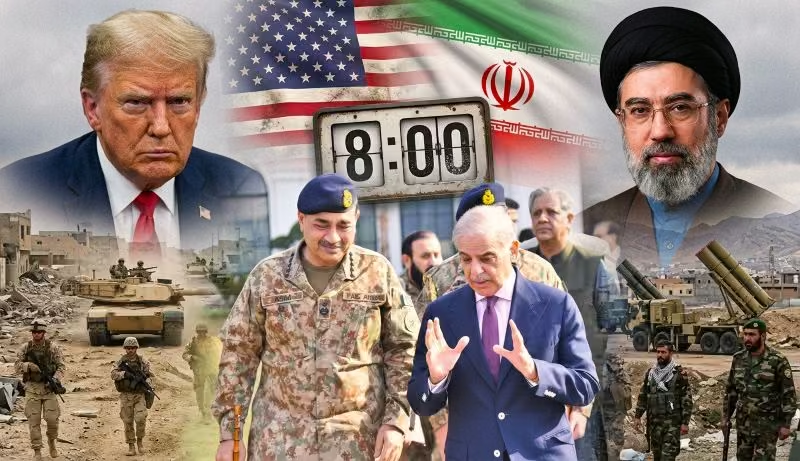
Forty-eight hours after a fragile two-week ceasefire pulled the United States and Iran back from the edge of an abyss, the world’s most consequential diplomatic encounter of 2026 was converging on Pakistan’s capital. Formal proximity talks between Washington and Tehran — the highest-level engagement between the two countries since 1979 — are scheduled to begin Saturday morning at the Serena Hotel. The format, the venue, and the entire diplomatic architecture bringing these talks into existence are Pakistani. So is the pressure to make them work.
The Night the Bombs Did Not Fall
The ceasefire that made these talks possible did not emerge from a summit or a communiqué. It came from an X post, a phone call — and then several more, through the night of April 8.
Field Marshal Asim Munir, Pakistan’s Chief of Defence Forces, spent the hours before a self-imposed US strike deadline in direct contact with Vice President JD Vance and Special Envoy Steve Witkoff, working through the technical framework of a pause. Prime Minister Shehbaz Sharif ran a parallel track — calls to Riyadh, Ankara, and Beijing, building the coalition of regional and international pressure needed to give both capitals a usable off-ramp. With minutes remaining before a deadline that the Trump administration had spent days making explicit, PM Sharif posted on X, requesting Trump to extend by two weeks and asking Iran to open the Strait of Hormuz as a goodwill gesture.
Trump announced the suspension of strikes ninety minutes before his own deadline expired, crediting the conversations with Sharif and Munir by name. Iranian Foreign Minister Abbas Araghchi confirmed acceptance within the hour. He also, in a moment that reverberated across diplomatic circles, publicly thanked Field Marshal Munir by name — calling him his “dear brother” and praising his “tireless efforts.” It was an extraordinary acknowledgement, from a Tehran that rarely offers such courtesies to foreign military figures.
Whether the precise choreography of the final hours was authored entirely in Rawalpindi or partly coordinated with Washington to give Trump the political cover to stand down is a question that has not been fully answered. A draft label that briefly appeared on an earlier version of the PM’s X post — visible for approximately sixty seconds before correction — has prompted sharper scrutiny of who, exactly, was writing the lines. Pakistan’s Foreign Office has not commented. The talks are still starting Saturday.
What Sharif Said — and the Word That Raised the Stakes
When PM Sharif stepped in front of the cameras Thursday evening to formally announce the Islamabad talks, his language was measured in every respect but one. He called it “a proud moment for Pakistan,” extended “heartfelt thanks” to both sides for trusting Islamabad to host the process, and described the goal as “meaningful and conclusive talks for a comprehensive settlement of all disputes.”
Conclusive. In diplomatic speech, that is not a neutral word. It sets an expectation, names an outcome, and implicitly holds the host accountable for delivering conditions that make it achievable. Sharif was not framing this as an open-ended exercise in dialogue management. He was declaring an ambition — and raising the stakes for every party preparing to arrive.
The Delegations: Who Is Coming
The American team is led by Vice President JD Vance, who departed Joint Base Andrews on Friday morning. He is accompanied by Steve Witkoff, Trump’s chief negotiator, and Jared Kushner, understood to be focused on Iranian ballistic missile constraints and regional proxy networks. The delegation is expected at Nur Khan Airbase late Friday night or in the early hours of Saturday. A 30-member US security advance team has been coordinating with Pakistani authorities since Thursday.
Before boarding, Vance offered Tehran a pointed message and a conditional welcome in the same breath. The US was willing to extend an “open hand,” but Trump had provided “pretty clear guidelines” and the delegation was not arriving to be “played.” Among the details the Iranians are tracking closely: their delegation regards Vance as the more pragmatic figure in the US team. Witkoff is viewed in Tehran with particular wariness, following what Iranian officials describe as US strikes timed to coincide with earlier rounds of talks in Muscat and Geneva.
Iranian media confirmed the delegation’s arrival in Islamabad in the early hours of Saturday morning, ending hours of deliberate ambiguity. Pakistan’s Foreign Office had expected a high-level team to land on Friday, led by Parliament Speaker Mohammad-Bagher Ghalibaf and Foreign Minister Abbas Araghchi. Iranian Ambassador Reza Amiri Moghadam briefly confirmed the delegation’s arrival on social media before deleting the post, citing it as “premature.” Press TV and Tasnim ran periodic reports suggesting the delegation had not left Iran and talks were “on hold” until Israeli strikes in Lebanon ceased. .
The mixed messaging is strategy, not confusion. Iran has spent weeks managing its own domestic calculus — an IRGC establishment deeply suspicious of negotiations, a pragmatic president in Masoud Pezeshkian who has publicly thanked Pakistan for the ceasefire, and a Parliament Speaker in Ghalibaf whose IRGC background gives him the authority to sell a deal that a career diplomat alone could not. For a delegation travelling to sit in proximity rooms with the country that killed their Supreme Leader six weeks ago, calculated ambiguity is the first and cheapest form of leverage.
The Format: No Handshakes, No Eye Contact
The talks will use a proximity format — a structure born of situations where the distrust between parties is too deep for direct negotiation. Both delegations will be housed in separate wings of the Serena Hotel. Pakistani officials, led by Ishaq Dar and the National Security Adviser, supported by military liaison officers, will shuttle proposals and counter-proposals between the rooms. There will be no joint sessions. No shared table. No cameras inside.
Pakistan is, quite literally, the wall between them that both sides have agreed to speak through.
What Is Actually on the Table
The gap between the two sides’ opening positions is vast, though not unbridgeable — if both parties decide they want a bridge.
Iran’s 10-point plan frames the recognition of Iranian sovereignty and economic rehabilitation as preconditions for any lasting settlement. The demands include: a binding US guarantee against future strikes; internationally recognised Iranian control over the Strait of Hormuz, including the right to charge a $2 million per-ship transit fee; formal acceptance of Iran’s right to continue uranium enrichment; the full lifting of all primary and secondary sanctions; the annulment of UN Security Council and IAEA resolutions; the release of all frozen Iranian assets; reparations for war damages; withdrawal of all US combat forces from the region; and a UN Security Council resolution to ratify any final agreement. Iran also insists the ceasefire must cover all fronts — Lebanon and Yemen included — as a non-negotiable condition.
The US has arrived with a 15-point framework focused almost entirely on dismantling Iranian strategic capabilities as a prerequisite for peace. Washington wants the complete termination of Iran’s nuclear programme — Natanz, Isfahan, and Fordow — and the transfer of all enriched stockpiles to the IAEA. It demands deep cuts to Iranian ballistic missile capabilities, an end to Iranian support for Hezbollah and the Houthis, and the immediate, unconditional reopening of the Strait of Hormuz with no Iranian toll regime or oversight role. Sanctions relief and the potential unfreezing of Iranian assets are offered as conditional rewards for verified compliance.
There is one item not listed on any official agenda. According to the Washington Post, the release of at least six Americans in Iranian custody — including Kamran Hekmati and Reza Valizadeh — is a secret top priority for the Vance team.
The two positions do not simply differ on details. They reflect incompatible visions of what a post-war Iran looks like. Washington wants a contained, defanged Iran. Tehran wants formal recognition as a regional power with a civilian nuclear programme, guaranteed by international law.
The Lebanon Problem
If the talks collapse before they begin, Lebanon will be the reason.
Iran has declared it a red line: the ceasefire covers all theatres. Ghalibaf has described a Lebanon ceasefire as a mandatory prerequisite for meaningful engagement. Israel’s position is the opposite. Prime Minister Benjamin Netanyahu stated categorically that there is “no ceasefire in Lebanon” and that Israel would continue striking Hezbollah “with full force.” Strikes in Nabatiyeh killed eight state security personnel after the ceasefire announcement. Washington has not publicly contradicted Netanyahu.
The matter was further complicated Friday by Pakistan’s own Defence Minister, Khawaja Asif, who described Israel as “evil” in remarks that drew an immediately “furious” response from Israeli Foreign Minister Gideon Sa’ar. The exchange landed at precisely the wrong moment, introducing bilateral friction into a mediation that depends on Islamabad being seen as genuinely neutral. Senior Pakistani officials scrambled to contain the damage. The talks must still begin Saturday. But the atmosphere in which they begin has been complicated by a minister who either did not calculate the cost of those words, or calculated it and chose to speak anyway.
The Architects: How Pakistan Built This
This did not happen overnight. And it was not the work of one institution, one phone call, or one relationship.
What is on display in Islamabad this weekend is a rare, synchronised effort between Pakistan’s civilian leadership and its military establishment — two institutions whose historical relationship has been defined more often by tension than trust. This time, they were reading from the same page. That alignment, more than any single diplomatic manoeuvre, is what made Pakistan a credible enough channel for both Washington and Tehran to use simultaneously.
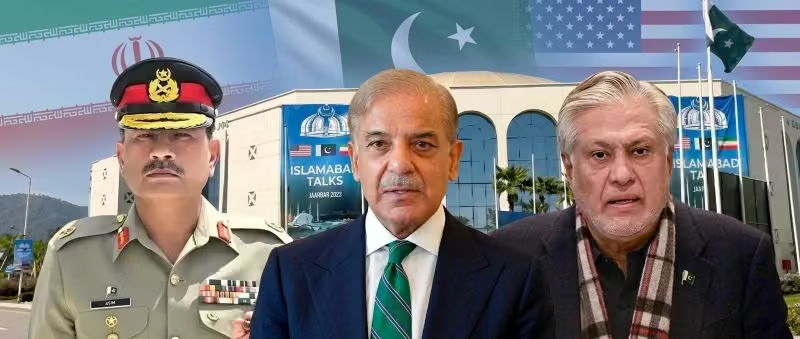
Shehbaz Sharif’s contribution was structural. Where other Pakistani leaders leaned into the crowd-pleasing line, Sharif spent months maintaining contact with Middle Eastern capitals and keeping the Washington channel open during periods when there was no obvious domestic credit to be earned from it. He positioned Pakistan as ground where both parties could feel their security and sovereign dignity would be respected — not because either loves Pakistan, but because both had concluded that Islamabad was the least hostile available intermediary. The word “conclusive” in Thursday’s address was a deliberate raising of the stakes. Sharif knows what he has committed to.
Field Marshal Munir’s role was equally indispensable, and Araghchi’s public thanks confirmed what was already understood in diplomatic circles. His direct personal access to the Trump White House — a channel that bypassed the conventional State Department routes that Tehran had stopped trusting — gave Pakistan a line to Washington that no European or Gulf capital could replicate. His guarantee of physical security for the Iranian delegation while on Pakistani soil was, according to sources familiar with the process, a prerequisite for Ghalibaf’s decision to travel. The broader philosophy at work — that economic stability underpins strategic relevance, and that a country managing its own collapse cannot credibly offer others a stable room — has shaped the Pakistan that was able to make this offer.
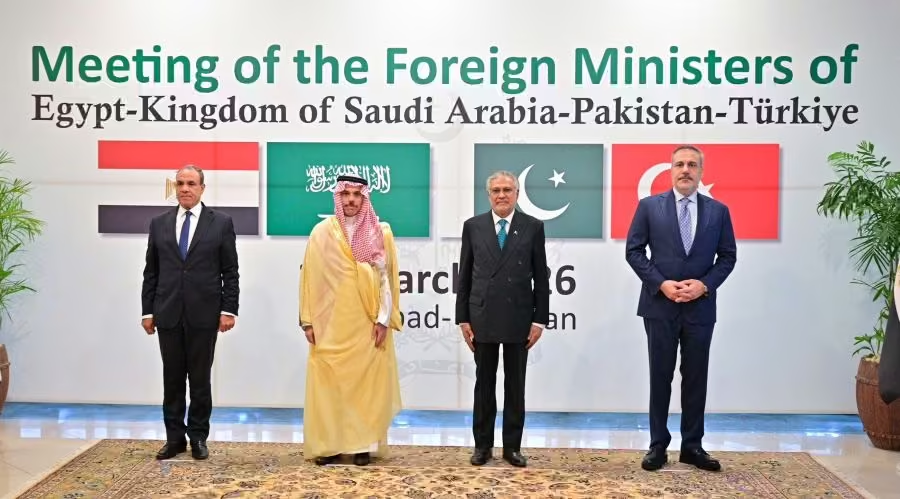
Ishaq Dar’s contribution was architectural in the most practical sense. He was supposed to be in Ankara for last month’s quadrilateral consultations. He stayed in Islamabad because he was too embedded in the back-channel relay work to leave. That single logistical fact says more about his role than any formal title does. The decision to grant visa-on-arrival to all official delegates and accredited international journalists was not a minor operational detail — it was a signal, to the world and to both delegations, that Pakistan had nothing to hide and every reason to be seen.
What the World Is Saying
The international response has been watching — and, in several cases, acknowledging — what Pakistan has pulled off.
Michael Kugelman of the Atlantic Council described Pakistan’s role as one of its biggest diplomatic moments in years, noting that Islamabad had “defied sceptics who didn’t think it had the capacity to pull off such a complex, high-stakes feat.” Dr Vali Nasr of Johns Hopkins University’s School of Advanced International Studies observed that both Washington and Tehran choosing Islamabad over other regional capitals reflects Pakistan’s “unique ability to work across the sectarian and geopolitical fault lines of the Muslim world.” Ambassador Maleeha Lodhi — whose diplomatic career spans decades — described the civilian-military coordination on display as Pakistan’s “Kissinger Moment”: the kind of strategic patience and precise execution that repositions a country in the global order.
Ali Vaez of the International Crisis Group offered the most structurally honest assessment: “We have a ceasefire that may or may not be in place, based on terms that may or may not be commonly understood, leading to negotiations that may or may not actually happen.” It is a sentence blunt to the point of poetry, and it is the frame within which every optimistic reading of these talks should be held.
The Analysts’ Assessment
Pakistan has earned this moment. That should be said plainly, without the performance of national pride and without the false modesty that sometimes passes for analytical rigour.
But it should also be said plainly that the talks may still fail. Trita Parsi of the Quincy Institute has noted that the war has, paradoxically, strengthened Iran’s economic hand — Tehran is currently selling oil at elevated prices, with some sanctions enforcement disrupted by the conflict. Iran is not a desperate party. It has absorbed serious damage and retains leverage, and knows it.
The structural gaps between the two positions are not rhetorical. They are generational. What Pakistan has achieved is getting both sides into the same city, willing to speak through the same intermediary. It cannot compel either side to say yes. It cannot stop Israel from striking Lebanon. It cannot resolve in fourteen days what has been unresolved for four decades.
The Islamabad City, the Stakes
Islamabad has been on a government-declared public holiday since Thursday, the second consecutive day of closures across the Islamabad Capital Territory and Rawalpindi to minimise movement and secure VVIP routes. The Islamabad Expressway from Zero Point to Koral Chowk has been subject to intermittent closures. International outlets — Al Jazeera, Reuters, CNN, BBC, and dozens more — are stationed outside the Red Zone perimeter, waiting for press releases and pre-recorded statements. The negotiating rooms themselves are, and will remain, strictly off-camera.
The economic numbers provide context. Shipping traffic through the Strait of Hormuz stands at roughly 90 per cent below normal — nine vessels transiting daily against an average of 138. Brent crude briefly fell below $100 per barrel following the ceasefire announcement. Pakistan’s rupee opened 0.45 per cent higher against the dollar this week. None of this is recovered ground. It is a pause in the bleeding, conditional on what happens inside the Serena Hotel over the next 48 hours.
China has been more than a spectator. Beijing provided the assurance that Iranian officials would not be targeted while on Pakistani soil — a prerequisite Ghalibaf required before agreeing to travel. The Five-Point Initiative agreed between FM Dar and Chinese FM Wang Yi earlier this year serves as the foundational regional framework within which these talks are operating. For China, the reopening of the Strait is an existential energy-security interest.
The mood among ordinary Islamabadis is a study in contradictions — pride that their city is at the centre of something historic, and unease about what happens if it goes wrong. “We are the peacemakers now,” one taxi driver outside Aabpara said Thursday evening. It was the kind of line that captures a national mood better than any analyst’s quote.
What Comes Next—after the Islamabad Talks
Saturday morning will be the test. If the Iranian delegation transfers from Nur Khan to the Serena Hotel, the talks proceed. If Tehran’s public statements harden into a formal refusal — citing Lebanon, Israeli strikes, or the Khawaja Asif controversy — the architecture of the last six weeks could collapse before the first message is shuttled between rooms.
For a nation that spent years as a footnote in other people’s geopolitical dramas, being the address where the United States and Iran sit in the same building and attempt to talk their way out of a war is something else. Pakistan did not stumble here. It built this, over months that the rest of the world was looking elsewhere — and when the moment came, the civilian and military leaderships moved together.
What it can do now — what it is doing tonight, as the Red Zone sits silent and the flags of three nations hang together on the avenues of a locked-down capital — is hold the table open.
For now, that is the whole job.
This is a developing story. Live updates will follow as delegations arrive and talks progress.