TOPLINE
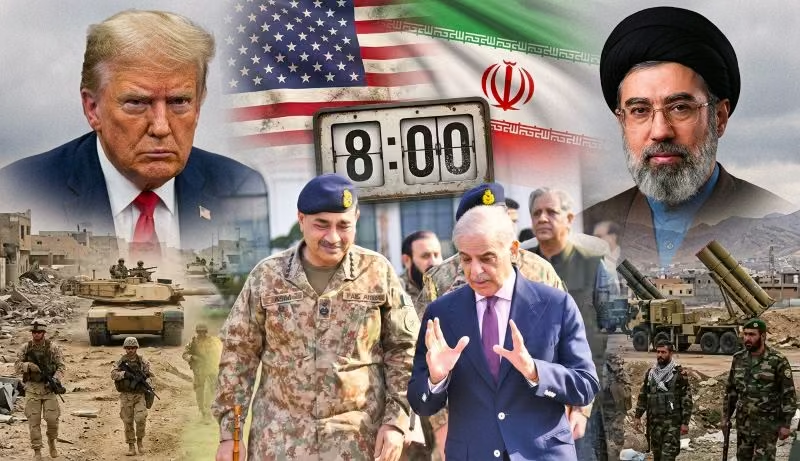
Pakistan brokered a two-week ceasefire between the US and Iran just before Trump’s midnight deadline, securing Islamabad as the venue for formal talks beginning 10 April. But a draft label accidentally left on PM Sharif’s X post has raised serious questions about who actually wrote the message that gave Trump his off-ramp — and the war itself remains very much alive.
The bombs did not fall.
That is the headline. Everything else — the all-night phone calls, the backroom proposals, the frantic last hours, the post on X that raised more questions than it answered — is the story of how Pakistan made that sentence possible.
At 6:32 PM Eastern Time on Tuesday, 8 April 2026 — roughly 90 minutes before his own deadline expired — US President Donald Trump posted on Truth Social that he was suspending all US and Israeli bombing of Iran for two full weeks. The condition: Iran must agree to the complete, immediate, and safe reopening of the Strait of Hormuz. Iran’s Supreme National Security Council and Foreign Minister Abbas Araghchi confirmed acceptance within the hour. Safe passage through the strait would be coordinated by Iran’s armed forces for 14 days, Tehran said. Formal negotiations between the US and Iran would begin in Islamabad on Friday, 10 April.
Pakistan had proposed exactly this. Pakistan is hosting those talks.
How a Country That Has Spent Years at the Edge of Bankruptcy Became the Room Where a War Was Paused
Pakistan did not stumble into this role. It built it, carefully, over weeks that the rest of the world’s attention was focused elsewhere.
The war began on 28 February, when the United States and Israel launched a joint strike on Iranian targets, killing Supreme Leader Ayatollah Ali Khamenei. His son Mojtaba assumed leadership. In the weeks that followed, the conflict spread — into Lebanon, Yemen, Iraq, and the Gulf. The Strait of Hormuz, through which roughly 20 per cent of the world’s oil and gas flows, became Tehran’s primary pressure point. For Pakistan, a country that imports the bulk of its crude from Gulf states and has millions of workers whose remittances cross through the same Gulf economies, this was never an abstract crisis.
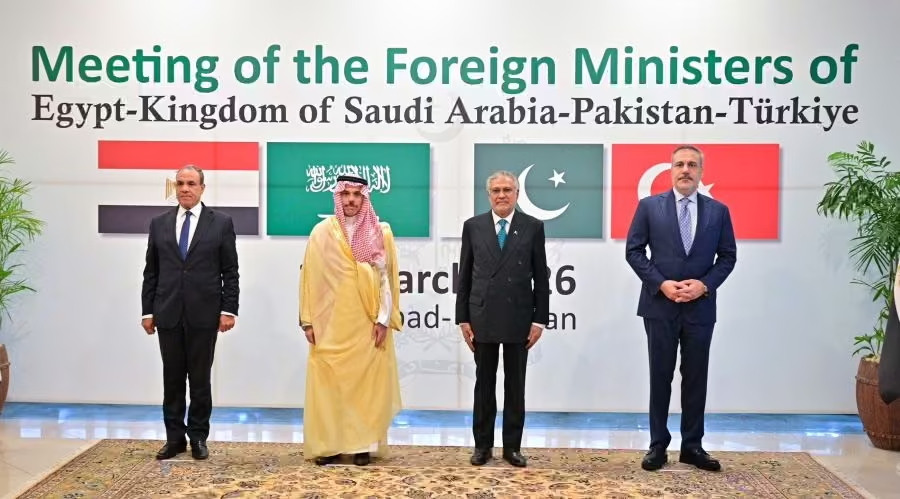
Islamabad positioned itself early. Deputy Prime Minister and Foreign Minister Ishaq Dar confirmed in late March that Pakistan was actively relaying indirect communications between Washington and Tehran — the US’s 15-point peace proposal went to Iran via Islamabad, and Iran’s responses came back the same way. When a quadrilateral meeting with the foreign ministers of Saudi Arabia, Türkiye, and Egypt had originally been planned for Ankara, it moved to Islamabad at the last moment because Dar was too embedded in the backchannel work to leave. That single logistical detail explained Pakistan’s position better than any press release.
On 29 March, PM Shehbaz Sharif publicly offered Pakistan as the venue for direct US-Iran negotiations. Trump reposted it on Truth Social — a gesture read in Islamabad as Washington’s quiet endorsement. Army Chief Field Marshal Asim Munir had established and maintained direct lines to US Vice President JD Vance, Special Envoy Steve Witkoff, and Iranian FM Araghchi. Egypt, Türkiye, and China ran parallel diplomatic tracks, but Pakistan was the central node. The “Islamabad Accord” — a two-phase proposal for an immediate ceasefire to reopen the strait followed by 15–20 days of structured talks — had been Islamabad’s formula from the beginning.
The Deadline and What It Actually Meant
Trump set the 8pm EDT deadline as the kind of ultimatum that demands a response — from Iran, from the world, and most uncomfortably, from himself.
The fear was real. In the days leading up to 8 April, Trump had threatened to destroy “every power plant and bridge” in Iran, warned that “a whole civilisation will die tonight, never to be brought back again,” and told Fox News anchor Bret Baier, simply: “8pm is happening.” Iran showed no signs of capitulating. Tehran had already rejected multiple temporary ceasefire proposals, insisting instead on a permanent end to hostilities, sanctions relief, security guarantees, and reconstruction commitments. Iran’s 10-point counter-proposal — which included accepted uranium enrichment rights, the lifting of all primary and secondary sanctions, and withdrawal of US combat forces from the region — was described by Trump as a “significant step” but “not good enough.” As of Tuesday afternoon, both sides were still talking through Pakistani channels, but Iranian officials had signalled they were “walking on thin ice.”
The honest question, which circulated in diplomatic circles and social media simultaneously, was whether the deadline was a genuine military commitment or an elaborate piece of pressure. Trump had already extended his threats without acting before. The apocalyptic language — “a whole civilisation will die” — was condemned by UN Secretary-General António Guterres, Iran’s ambassador to the UN, legal experts who said the phrasing could constitute a threat of genocide under international law, and Türkiye’s President Erdoğan, who said Ankara did not approve of the “total destruction of Iran.”
But the fear was also legitimate. Nobody outside the Oval Office and possibly the Pentagon actually knew what Trump would do if the clock ran out with no deal. Iran had spent weeks creating precisely that strategic ambiguity — no one knew with certainty what Iran’s retaliatory capacity looked like, which targets across the Gulf, the Middle East, and global tech infrastructure it had mapped, or how far Tehran would go if the strikes hit civilian infrastructure. The uncertainty was Iran’s most effective weapon, and both sides knew it.
Trump needed an off-ramp. Iran needed one that did not look like surrender. Pakistan had been offering that off-ramp for weeks.
The Last Hours
As 8 April arrived in Islamabad, Pakistani officials intensified what sources inside the Foreign Office described as the most concentrated burst of diplomacy in the country’s recent history. Army Chief Munir kept his direct line to JD Vance open. Dar made four phone calls in under thirty minutes to the foreign ministers of Saudi Arabia, Türkiye, Morocco, and Egypt. Messages continued to flow to Tehran. One security official, speaking off the record in the early hours, told reporters the next few hours were “decisive.”
With only hours remaining, PM Shehbaz Sharif posted on X. He requested Trump to extend the deadline by two weeks. He requested Iran to open the Strait of Hormuz as a goodwill gesture for a corresponding period. He urged all parties to observe a ceasefire everywhere — including Lebanon. The post tagged Trump, Vance, Witkoff, and Secretary of State Marco Rubio.
Ninety minutes later, Trump announced the suspension of strikes on Truth Social, crediting conversations with Sharif and Munir directly.
The Post That Raised the Question Everyone Is Now Asking
The PM’s X post did the job it needed to do. What followed it — within hours, from sharp-eyed users on the same platform — was a different story.
Social media researchers noticed that an earlier draft of the PM’s post had remained visible for approximately one minute before the final version was published. That draft was headed with the label: “Draft – Pakistan’s PM Message on X.” The framing was in English, referred to Sharif in the third person as “Pakistan’s PM,” and was structured in a way that Sharif’s own staff would have no reason to write.
Ryan Grim, founder of the Drop Site newsletter, noted publicly that the post’s authorship appeared external to Pakistan — likely written by the US side, possibly by Trump’s own team. Others drew an obvious conclusion: Trump wanted the ceasefire but did not want to appear to have initiated the retreat himself. A message from Pakistan’s PM requesting a two-week extension gave him the political cover to stand down without appearing to blink. Someone, as one widely circulated post put it, “left the draft label in.”
Pakistan’s Foreign Office did not respond to requests for comment on the matter.
This is where the analysis must be careful — and honest. The draft label is a fact. The inference that follows is logical but unconfirmed. What is certain is that the formula in Sharif’s post — two weeks, open Hormuz, goodwill gesture — was Pakistan’s own proposal, the same one Islamabad had been pushing through backchannels for weeks. Whether the precise wording of a social media post was drafted in Rawalpindi or relayed from Washington is, in one sense, a secondary question. In another, it is the entire question — because it determines whether Pakistan was the author of this diplomatic outcome or the instrument of someone else’s face-saving exercise.
The truth, as is usually the case in high-stakes diplomacy, is probably both. Pakistan had the formula. Washington needed a vehicle. The two are not mutually exclusive — and the fact that Islamabad’s proposal became the one Trump accepted, publicly and by name, is not nothing. But the edited post is a detail that will follow this episode into the history books, and it deserves honest acknowledgement rather than convenient burial in national pride.
The Saudi Shadow
The ceasefire was achieved. The strategic discomfort was not.
Iran’s overnight drone and missile strikes on Saudi Arabia’s Jubail Industrial City — targeting the Sadara petrochemical complex, one of the Middle East’s largest chemical facilities — hit Pakistan’s mediation like a secondary explosion. Pakistan’s Foreign Office issued an immediate and unequivocal condemnation, calling it a “serious violation of Saudi Arabia’s sovereignty” and a “dangerous escalation that undermines regional peace and stability.” ISPR called it “an unnecessary escalation which spoils sincere efforts to resolve the conflict through peaceful means.” PM Sharif telephoned Crown Prince Mohammed bin Salman directly to reaffirm “unflinching solidarity.”
That is the other line Pakistan has been walking throughout this crisis. Saudi Arabia is Pakistan’s most critical Gulf ally — economically, strategically, and through a mutual defence pact that does not disappear simply because Islamabad is also Tehran’s trusted channel. Iranian strikes on Saudi energy infrastructure do not just complicate the mediation; they activate a set of obligations that Pakistan’s security establishment takes seriously. A senior official was overheard in the Foreign Office corridors saying: “We saved the region from one fire, but our Saudi brothers are still angry. That defence pact isn’t going anywhere.”
The ceasefire may hold for 14 days. The Saudi-Iran tension will outlast all of them.
What Pakistan Actually Achieved—and What It Did Not
By dawn on Wednesday, Islamabad had delivered something the United Nations Security Council could not. The UNSC resolution backed by Bahrain and Gulf states — a diluted text calling for Iran to end its attacks on commercial vessels and halt interference in the Strait of Hormuz — failed when China voted against it, eliminating the last multilateral framework for a negotiated solution. Pakistan delivered what the Security Council could not produce: a concrete, named, credited outcome with a date and a venue attached.
The war that began on 28 February is not over. The 10-point Iranian proposal — which includes uranium enrichment rights, sanctions relief, and withdrawal of US forces from the region — represents a set of demands Washington has not formally accepted. Trump called it a “workable basis.” That is not the same as a deal. The strait is open for two weeks, monitored hour by hour. One tanker incident, one Israeli strike, one intelligence failure could collapse the table entirely.
What Pakistan has, for the next 14 days, is this: the talks come to Islamabad. The US and Iranian delegations will sit in the same city. The world’s most dangerous open conflict will be managed, at least temporarily, from a capital that most people assumed was too distracted by its own crises to matter on the global stage.
In the corridors of the Foreign Office as dawn broke over the Margalla Hills, the exhausted aides who had been on their phones all night were drinking doodh-patti and trading quiet smiles. There were no announcements. No chanting. One senior diplomat, speaking off the record, said simply: “We were the only ones both sides still trusted enough to pass the final messages.”
That is either the definition of successful diplomacy, or the description of a country used by larger powers who had already agreed on the outcome and needed a plausible stage. Possibly, this time, it was both.
The war is paused. The talks begin Friday. The hard work has not yet started.