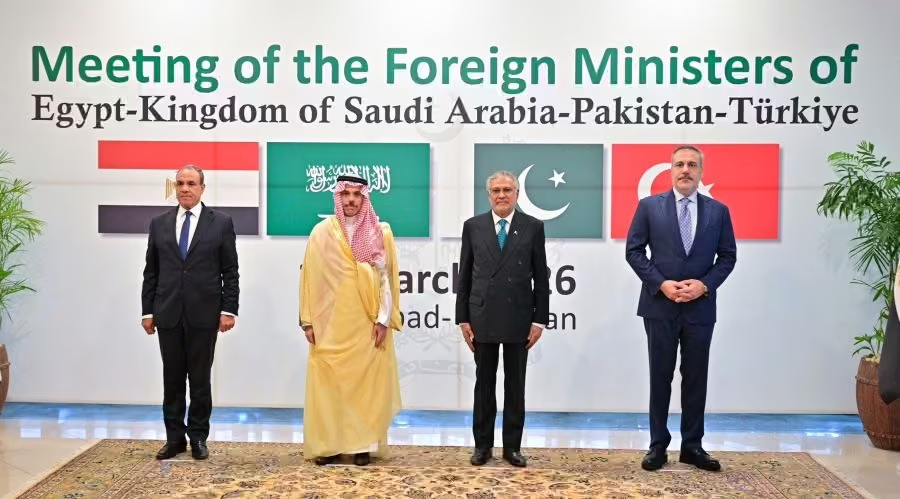
The foreign ministers of Saudi Arabia, Türkiye, and Egypt flew into Islamabad on Saturday and Sunday, held a day of intense diplomacy, and left the same evening—their visit shorter than planned, but their collective message unmistakable: the world’s most serious effort to end the US-Israeli war on Iran now runs through Pakistan’s capital.
The quadrilateral consultations, convened at the invitation of Deputy Prime Minister and Foreign Minister Ishaq Dar, were originally scheduled across two days, March 29–30. They concluded in one. All three visiting ministers held bilateral meetings with Dar, sat together for the formal four-nation session at the Foreign Office, called on Prime Minister Shehbaz Sharif, and departed the same night. The flags of all four nations flew outside the ministry. Several roads leading into Islamabad’s Red Zone were sealed. One of the largest media scrums the capital had seen in years pressed against the Foreign Office margins, waiting.
What came out of the room was more concrete than most expected.
How Pakistan Got Here
Pakistan did not arrive at this table by accident, and the meeting itself was not originally supposed to be held here. It was planned for Ankara. It moved to Islamabad at the last moment because Dar could not travel — he was too deeply embedded in the back-channel work of relaying messages between Washington and Tehran to step away.
That detail says everything about where Pakistan now stands.
Over the preceding weeks, Islamabad had quietly positioned itself as the primary intermediary between two sides publicly denying they were talking. Dar confirmed on Thursday that Pakistan was actively relaying indirect communications between the US and Iran, with Turkiye and Egypt running parallel tracks. The 15-point US peace proposal — demanding Iran dismantle its nuclear programme, curb missile development, and effectively relinquish control of the Strait of Hormuz — was transmitted to Tehran via Islamabad. Iran’s response came back the same way.
Tehran’s counter-position, according to officials familiar with the process, included an end to hostilities, reparations for war damages, guarantees against future attacks, and recognition of its strategic leverage over Hormuz. Iran has also laid out five formal conditions for ending the war.
Prime Minister Shehbaz Sharif had formalised Pakistan’s offer earlier in the week, publicly proposing the country as a venue for direct US-Iran negotiations. The offer gained unusual weight when US President Donald Trump reposted it on his Truth Social platform — a gesture widely read in Islamabad as Washington’s tacit approval of Pakistan’s role. Hours before Sunday’s meeting opened, PM Shehbaz held a 90-minute telephone call with Iranian President Masoud Pezeshkian — his second conversation with the Iranian leader in five days. Pezeshkian warned that Israel was attempting to expand the conflict to other countries and expressed concern over the use of foreign territory for attacks on Iran.
China, meanwhile, conveyed support to Tehran for Pakistan’s mediation efforts and encouraged Iran to engage with the diplomatic process — a signal that major powers were beginning to line up behind the regional initiative.
What the Four Nations Agreed
The second quadrilateral session — the first had been held in Riyadh on March 19 — produced a formal outcome document: a seven-point Host Summary, issued by Pakistan’s Foreign Office as official statement 82/2026, dated Islamabad, March 29, 2026.
In it, the four foreign ministers expressed shared concern at the “devastating impact on lives and livelihood across the wider region” and agreed that the war “is not in favour of anyone.” They reaffirmed unity to contain the situation, reduce the risk of military escalation, and create conditions for structured negotiations between the relevant parties. They called for upholding the principles of the UN Charter, including respect for sovereignty and territorial integrity of all states. A committee of senior officials from all four foreign ministries was to be constituted to work out modalities going forward.
Dar, in his post-session statement, delivered the day’s most significant line: both the United States and Iran had expressed confidence in Pakistan to facilitate direct talks between them. “Pakistan will be honoured to host and facilitate meaningful talks between the two sides in the coming days,” he said, “for a comprehensive and lasting settlement of the ongoing conflict.”
He added that Chinese FM Wang Yi and the UN Secretary General had both extended full backing for Pakistan’s peace initiative, as had counterparts from multiple countries reached by telephone.
The four visiting ministers gave their “fullest support” to Pakistan’s initiative to host the talks.
What the Bilaterals Covered
Ahead of the formal session, Dar held separate bilateral meetings with each of the three counterparts.
With Turkish FM Hakan Fidan, both sides reaffirmed the Pakistan-Türkiye strategic partnership, reviewed the full spectrum of bilateral relations, and stressed sustained diplomatic engagement on Iran. Both sides expressed unwavering support for each other’s core national interests.
With Egyptian FM Dr Badr Abdelatty — whose visit was a follow-up to high-level contacts in Riyadh earlier in March and Abdelatty’s Pakistan trip in November 2025 — discussions covered de-escalation, Palestinian solidarity, defence cooperation, bilateral trade, and the activation of a Joint Ministerial Commission. Dar reaffirmed Pakistan’s support for the Palestinian people and condemned Israeli aggression in Gaza and the West Bank, appreciating Egypt’s role in facilitating humanitarian assistance to Gaza. Both sides agreed to coordinate at the UN and OIC.
With Saudi FM Prince Faisal bin Farhan, the two sides underscored the importance of dialogue and collective efforts for regional peace, reaffirmed their commitment for closer engagement, and agreed to coordinate at bilateral and multilateral levels.
All three ministers also called on Prime Minister Shehbaz Sharif at the Prime Minister’s Office. With Fidan and Abdelatty, Sharif stressed the urgent need to end hostilities “causing heavy loss of life, economy and property not only in Iran, but across several brotherly Muslim countries.” With Prince Faisal, he praised Saudi Arabia’s “remarkable restraint” during the conflict, conveyed warm regards to King Salman and Crown Prince Mohammed bin Salman, and underscored the importance of unity among Islamic countries.
Iran’s Position: Cautious, Not Closed
Tehran’s public posture throughout the day was carefully calibrated. Government spokesperson Fatemeh Mohajerani said Iran “is willing to move toward a sustainable peace,” while reiterating its conditions: compensation for war damages, lifting of sanctions, and resolution of the Hormuz question. Iran has not participated in the quadrilateral framework directly, and its Foreign Ministry clarified that Tehran had not engaged in direct negotiations with Washington. Iranian Parliament Speaker Mohammad Bagher Ghalibaf went further, accusing the US of “openly sending a message of negotiation while secretly planning a ground attack.”
The gap between Iran’s public position and its back-channel engagement remained the central ambiguity of the day — and the central challenge for everything Islamabad was attempting.
A Confidence-Building Gesture
A day before the meeting, Dar had announced a small but telling development: Iran agreed to allow 20 additional Pakistani-flagged vessels to transit the Strait of Hormuz, two per day. Dar called it “a harbinger of peace.” The Strait — through which roughly a fifth of the world’s oil passes — has been the war’s sharpest economic pressure point. For Pakistan specifically, the costs have been tangible: fuel import bills up, shipping insurance surged, remittances from millions of Pakistanis across the Gulf under threat.
The War They Were Trying to End
The conflict that brought these ministers to Islamabad began on February 28, when the United States and Israel launched what they described as a “pre-emptive” joint strike on Iranian targets. Supreme Leader Ayatollah Ali Khamenei was killed in those initial strikes. His son Mojtaba has since assumed leadership of the country.
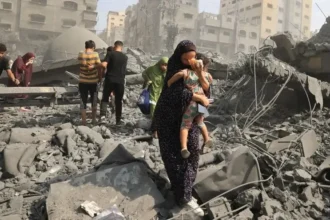
In the weeks that followed, the war spread. Lebanon absorbed over 1,180 dead since Israeli strikes escalated on March 2, with healthcare workers and journalists among the killed. Yemen’s Houthi rebels entered the conflict, firing missiles toward Israel. Iraq saw strikes on Iran-aligned paramilitary positions. Kuwait’s airport radar was knocked out in a drone attack. Iran’s internet entered its 30th consecutive day of blackout. In Washington, exiled Iranian royalist Reza Pahlavi drew standing ovations at CPAC, urging the US to press its military campaign and pursue regime change in Tehran — the loudest counter-narrative to everything being attempted in Islamabad.
From the Corridor
The meeting that may help end a regional war was held, as diplomats prefer, behind closed doors. Outside the Foreign Office, journalists from across the region waited in one of the largest media scrums Islamabad had seen in years. Officials walked past with studied purpose, eyes forward.
The one figure impossible to miss throughout the day was Dar himself — chairing the session, working the phones, keeping Tehran on the line, staying in Islamabad when others were travelling. It is worth pausing on that. Not long ago, Dar was a punchline in Pakistani political conversation — the finance minister whose tenures became synonymous with economic mismanagement. On Sunday, his name was in diplomatic dispatches from Ankara, Riyadh, Cairo, Tehran, Beijing, and the UN. Whether history will be generous about how Pakistan arrived at this moment is a separate question. What was not in dispute, on this day, was who was running the room.
A minor footnote the cameras did not capture: Egypt’s FM Abdelatty was the only one of the three visiting ministers who travelled commercially, flying in and out of Islamabad International Airport. His Turkish and Saudi counterparts arrived and departed on their governments’ official aircraft, using Nur Khan Airbase. Nobody said anything about it. Nobody needed to.
What Comes Next
Pakistan can keep the conversation alive and give both sides a room that neither has to officially acknowledge. That is what it did on Sunday. Whether the Islamabad talks produce a concrete mechanism or remain a statement of collective intent will ultimately depend on decisions made in Washington and Tehran, not Islamabad.
A diplomatic source indicated that direct US-Iran talks, potentially led by US Secretary of State Marco Rubio and Iranian FM Abbas Araghchi, could take place in Islamabad within days. Germany’s FM had said publicly such a meeting would happen “very soon.” One diplomat tracking the talks suggested Washington might announce a ceasefire to coincide with the start of dialogue — though all of it, the source cautioned, remained subject to the next 48 hours.
As a senior Pakistani official put it: “We can take the horse to the water. Whether the horse drinks or not is entirely up to them.” Al Jazeera
For now, Pakistan is the room where that question is being asked — and the four flags that flew outside the Foreign Office on Sunday are the clearest sign yet that it is not asking alone.